Indice
Versione verificata
| Provider | math.numeric 1.14.0 |
|---|---|
| API | NUMERIC_API_v1 · api_version=1 |
| Framework | GX-TXT 0.9.8.10-dev-031 |
1. In parole semplici
È la “cassetta degli attrezzi matematica” comune di GX-TXT. Un modulo che deve interpolare, fare una regressione, calcolare una derivata o risolvere una matrice non dovrebbe incorporare una propria implementazione privata se la stessa operazione è già disponibile qui.
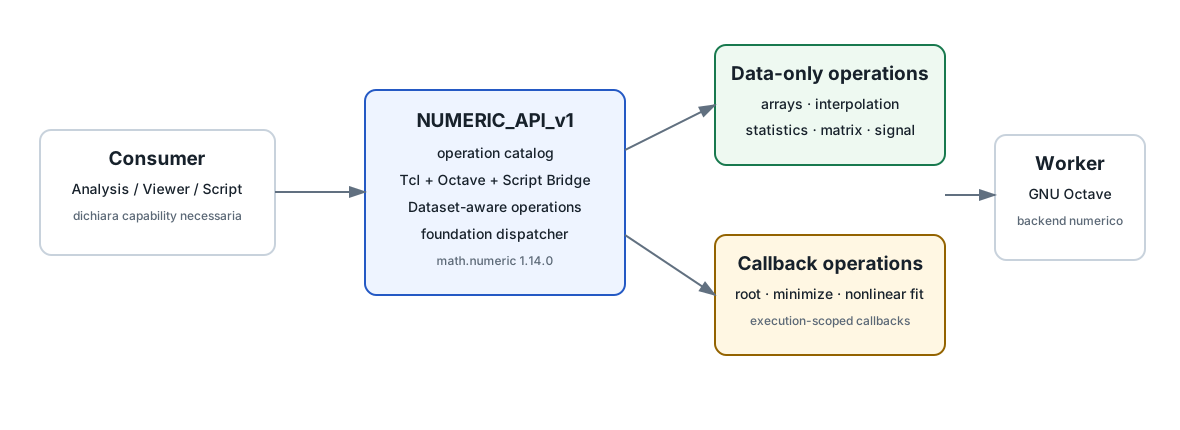
2. Perché è un'API e non un modulo da Run
math.numeric è un servizio protetto runner=service. I consumer scoprono l'API, verificano capability e invocano operazioni. Questo separa il “motore matematico” dal workflow scientifico che decide quali Dataset usare e come interpretare il risultato.
3. Catalogo delle possibilità
| Famiglia | Operazioni |
|---|---|
| Elementwise / array | array_unary.*, array_binary.*, array_compare.*, array_mask.*, array_select, array_where |
| Reductions | array_reduce.sum/mean/median/std/variance/rms/min/max/quantile/product/argmin/argmax/count/any/all, reduce_summary, reduce_accumulate |
| Complex | complex_unary.*, complex_binary.*, unwrap |
| Interpolation / grid | interpolate, resample, resample_uniform, spline_create/evaluate/integral, grid_info, validate_monotonic, uniform_grid, common_range |
| Calculus | integrate, cumulative_integrate, differentiate, cumulative_sum |
| Statistics | statistics, rank, covariance, correlation, mad, histogram, ecdf, normal_cdf, student_t_cdf/quantile, f_cdf, hypothesis_test, one_way_anova, matrix_statistics, residual_metrics, quantiles, weighted_quantiles, weighted_statistics |
| Linear algebra | matrix_svd, linear_matrix |
| Vector / random | vector_normalize, vector_similarity, resample_indices |
| Fitting / optimization | least_squares, linear_regression, polynomial_fit/evaluate, nonlinear_fit, root_find, minimize_1d, minimize |
| Signal primitives | smooth, digital_filter, find_peaks, baseline, fft, ifft, analytic_signal, frequency_grid, one_sided, detrend, window, configure_fft_threads |
| Uncertainty | propagate_uncertainty |
| Dataset-aware | dataset_array_*, dataset_integrate/cumulative_integrate/differentiate, dataset_interpolate/resample/resample_uniform, dataset_statistics/reduce_summary/weighted_statistics/grid_info, dataset_polynomial_fit/nonlinear_fit, dataset_smooth/find_peaks/baseline |
| Advanced foundation | foundation(family, action, a, b, c, options) |
4. Statistica
La stessa API contiene sia primitive classiche (statistics, covariance/correlation, MAD, histogram, ECDF, quantili) sia inferenza (hypothesis_test, one_way_anova, probability CDF/quantile) e un gruppo foundation.statistics con metodi robusti, bootstrap/permutation, multiple testing, logistic regression, GLM, survival e clustering.
5. Fitting e ottimizzazione
least_squares, linear_regression, polynomial_fit sono data-only. nonlinear_fit, root_find, minimize_1d e minimize usano callback nel binding Octave/Script Bridge.
6. Complex linear algebra
linear_matrix copre inspect, identity/transpose, multiply, solve, inverse/pseudoinverse, LU/QR/Cholesky/SVD, eigen/generalized eigen e matrix exponential/integer power. Supporta matrici reali e complesse con diagnostica di rank/condition number.
7. Foundation dispatcher
| Family | Actions |
|---|---|
family | align, surface, derivative, extrema, envelope |
tensor | transpose, conjugate_transpose, trace, symmetric_part, antisymmetric_part, contract, apply, outer |
scattered | interpolate |
vector | dot, cross, norm, normalize, outer, projection, angle, triple, contract |
grid | interpolate, sample, compatible, resample |
calculus | integrate2, integrate3, weighted_integral, gradient_grid, line_integral, line_scalar_integral, surface_flux, surface_integral, gradient, jacobian, hessian, directional |
special | erf, erfc, gamma, log_gamma, beta, incomplete_gamma, incomplete_beta, Bessel J/Y/I/K, spherical Bessel, airy, exponential_integral, sinc |
geometry | plane/frame operations, centroid, trajectory/plane intersections, mesh section, nearest/KD-tree, distances, areas/volumes, barycentric, fit/rigid transform, Delaunay/Voronoi, orientations, smoothing/remesh/boolean/volume slice |
sparse | construct, matvec, solve, least_squares, eigen_subset |
equations | solve, multiple_start, continuation |
variational | action, functional, legendre, first_variation, euler_lagrange_residual, constrained |
statistics | confidence_interval, robust_location, robust_regression, covariance_diagnostics, partial_correlation, multiple_testing, bootstrap_ci, permutation_test, logistic_regression, glm, survival_kaplan_meier, kmeans |
ode | solve |
constrained | solve |
8. Regole comuni
- Molte curve operations richiedono X strettamente crescente.
- Nonfinite values richiedono policy esplicita dove supportata.
- Le unità non vengono magicamente convertite dai raw mathematical calls.
- Dataset-aware calls usano Dataset ID + Variable ID e possono applicare Selection pubbliche.
- Weights zero vengono esclusi; semantics relative/inverse-variance sono distinte nei fitting che le supportano.
9. Discovery
Tcl:
::GX::NumericAPIv1::listOperations
::GX::NumericAPIv1::operationMetadata <id>

Octave:
gxtxt_numeric_v1('list_operations')
gxtxt_numeric_v1('operation_metadata', id)
10. Script Bridge
Nella dev-031 la binding Script Bridge espone i dispatcher principali array_*, foundation, linear_matrix, statistiche Dataset-aware selezionate e le operazioni callback di root/minimize/nonlinear fit. Il catalogo pubblico completo è più ampio del solo elenco top-level del Bridge.
11. Da dove partire
Riferimento tecnico completo
Questa parte raccoglie integralmente la documentazione tecnica pertinente distribuita con GX-TXT per gli argomenti e i moduli trattati in questa pagina.
`NUMERIC_API_v1`
NUMERIC_API_v1
SPDX-License-Identifier: GPL-3.0-or-later
1. Scope and stability
NUMERIC_API_v1 is the public mathematical/numerical
service of bundled CORE module math.numeric. API version
1 is independent of the GX-TXT release number and of the
module implementation version. Existing v1 calls are retained where
practical; new methods/results may be added additively without changing
established call signatures.
The API provides mathematical primitives. It includes reusable FFT/IFFT, analytic-signal construction, transform-coordinate, detrending and window-generation primitives, but it does not define domain-specific spectrum/PSD workflows, model-specific fitting semantics, chromatographic interpretation, UV/Vis interpretation or chemistry-specific processing.
2. Discovery
Consumers discover NUMERIC_API_v1 from
math.numeric/module.ini and use the advertised Tcl
entrypoint or Octave entrypoint. Do not source runtime/
files.
Tcl:
source $advertised_entrypoint
set info [::GX::NumericAPIv1::apiInfo]
if {![::GX::NumericAPIv1::supports polynomial_fit]} { error "polynomial fitting unavailable" }
Octave modules obtain the advertised Octave API directory/function and call:
out = gxtxt_numeric_v1(operation, ...);The public operation catalog is data-only and available without invoking the numerical worker:
set ids [::GX::NumericAPIv1::listOperations]
set meta [::GX::NumericAPIv1::operationMetadata array_reduce.mean]
set byName [::GX::NumericAPIv1::operationByExpressionName mean]
Octave offers gxtxt_numeric_v1('list_operations'),
gxtxt_numeric_v1('operation_metadata', id), and
gxtxt_numeric_v1('operation_by_expression_name', name) with
the same source catalog. Each record declares bindings, data-operand
arity (excluding family selector and optional options struct), argument
kinds, shape/broadcast rules, options, result shape, nonfinite policy,
unit behavior, and capability.
Callback-bearing operations (nonlinear_fit,
dataset_nonlinear_fit, root_find,
minimize_1d, minimize) are Octave-binding
operations. The Tcl worker deliberately does not serialize executable
functions.
2.1 Public binding inventory
The Tcl facade exposes data-only operations: arrayUnary,
arrayBinary, arrayCompare,
arrayMask, arraySelect,
arrayWhere, arrayReduce,
complexUnary, complexBinary,
unwrap, rank, covariance,
correlation, mad, histogram,
ecdf, normalCdf, studentTCdf,
fCdf, matrixSvd, resampleIndices,
normalizeVector, vectorSimilarity,
fft, ifft, analyticSignal,
frequencyGrid, oneSided, detrend,
window, interpolate, resample,
resampleUniform, splineCreate,
splineEvaluate, splineIntegral,
integrate, cumulativeIntegrate,
differentiate, gridInfo,
validateMonotonic, uniformGrid,
commonRange, statistics,
quantiles, weightedQuantiles,
cumulativeSum, weightedStatistics,
leastSquares, linearRegression,
polynomialFit, polynomialEvaluate,
smooth, digitalFilter, findPeaks,
baseline, baselineAnchored,
propagateIndependentUncertainty,
propagateCovariance, and the Dataset-aware commands listed
in section 15.
The Octave dispatcher additionally exposes callback-bearing
operations: nonlinear_fit,
dataset_nonlinear_fit, root_find,
minimize_1d, and minimize.
2.2 Complex linear algebra extension (math.numeric 1.10.0)
linear_matrix(action, A, B, options) is an additive
NUMERIC_API_v1 operation. It uses GNU Octave’s
LAPACK-backed matrix operations; no new native runtime or worker pool is
introduced. A and optional B are nonempty
finite two-dimensional real or complex numeric arrays in Octave. The Tcl
facade and Script Bridge accept
{"real": matrix, "imaginary": matrix};
imaginary may be omitted for real input. A right-hand-side
vector is an N x 1 matrix. Real and imaginary shapes must
match. Empty matrices and NaN/Inf input are rejected. Inputs are
dimensionless mathematical values: callers remain responsible for
compatible physical units.
Octave:
gxtxt_numeric_v1('linear_matrix', action, A, B, options);
pass [] for unused B. Tcl:
::GX::NumericAPIv1::linearMatrix $action $A ?$B? ?$options?.
Script Bridge in either language:
gxtxt_api_call('NUMERIC_API_v1', 'linear_matrix', {action, A, B})
(Python uses a list). For options without B, pass an empty
second operand.
gxtxt_api_require('NUMERIC_API_v1@1:math.numeric+complex_linear_algebra')
provides preflight.
Actions and result fields:
| Action | Contract | Added result fields |
|---|---|---|
inspect |
Any matrix; trace/determinant only when square | hermitian, symmetric,
positive_definite, norm_one,
norm_frobenius, norm_infinity, optional
trace_*, determinant_* |
identity, transpose,
conjugate_transpose, diagonal |
Identity matches A shape; diagonal extracts a matrix diagonal or constructs a diagonal matrix from a vector | value_real, value_imaginary |
multiply |
columns(A) = rows(B) |
value_* |
solve |
rows(A) = rows(B); multiple RHS columns allowed |
value_*, residual_*,
residual_norm, relative_residual,
rhs_columns, solution_kind |
inverse, pseudoinverse |
Inverse requires nonsingular square A; pseudoinverse uses SVD threshold | value_* |
lu, qr, cholesky,
svd |
LU square; QR any shape; Cholesky Hermitian positive definite; SVD economy form | l_*, u_*, p_*;
q_*, r_*, p_*; r_*;
or u_*, s_*, v_* |
eigen, hermitian_eigen,
generalized_eigen |
Square A; Hermitian check for named action; generalized requires equally shaped B | eigenvalues_*, eigenvectors_* |
exponential, power |
Square A; power requires integer options.exponent |
value_* |
Every result also contains rows, cols,
numerical rank, rank_tolerance, and
condition_number. All array results use paired
*_real/*_imaginary fields, including real
arrays (zero imaginary part). Octave reconstructs with
complex(result.value_real, result.value_imaginary). Tcl
returns row lists for matrices and flat lists for vectors. Script Bridge
returns numeric arrays. LU satisfies P*A=L*U; QR satisfies
A*P=Q*R; SVD satisfies A=U*S*V'. Eigenvector
ordering and phase are backend-dependent; verify eigenpair residuals
rather than exact eigenvector bytes.
solve defaults to rank_policy='error',
rejecting rank deficiency. rank_policy='minimum_norm' uses
the Moore-Penrose pseudoinverse for underdetermined or rank-deficient
problems. Full-rank overdetermined systems use least squares.
rank_tolerance is a nonnegative singular-value threshold;
by default it is max(size(A))*eps(max(svd(A))). Inverse and
default solve reject condition_number > condition_limit
(default 1e12); an explicit larger finite limit permits an
informed ill-conditioned calculation. These checks are diagnostics, not
guarantees of accuracy. relative_residual divides by
max(norm(B,'fro'),eps). Matrix exponential uses Octave
expm; matrix power uses integer powers. Matrix logarithm
and square root remain P1 work.
Invalid inputs return GXTXT:Numeric:* Octave
identifiers; the Tcl facade and Script Bridge preserve a useful error
message. Notable errors are InvalidOperand,
DimensionMismatch, RankDeficient,
IllConditioned, NotHermitian,
NotPositiveDefinite, InvalidTolerance, and
InvalidExponent. The existing Dataset representation is
unchanged: callers read canonical variables through Dataset APIs, then
pass explicit matrix values to this raw mathematical service.
Python Script Bridge example:
from gxtxt import gxtxt_api_call
result = gxtxt_api_call("NUMERIC_API_v1", "linear_matrix", [
    "solve", {"real": [[2, 1], [1, 3]]}, {"real": [[1], [2]]}
])
assert abs(result["value_real"][0] - 0.2) < 1e-12
3. Common numerical rules
Most low-level curve operations use real numeric data. The Octave
fft operation additionally accepts complex numeric vectors;
transform results are returned as separate real/imaginary vectors so the
public contract remains transportable. Unless stated otherwise,
nonfinite='error'; nonfinite='omit' explicitly
discards invalid observations/pairs where omission has a well-defined
meaning. No operation silently sorts X, merges duplicate coordinates, or
converts units.
Interpolation, resampling, spline construction, integration, cumulative integration, differentiation, smoothing and peak primitives require strictly increasing X. Duplicate or decreasing/non-monotonic X produces an error. Polynomial/regression/nonlinear fitting does not require sorted X and preserves repeated observations.
Weights are non-negative observation weights. Zero-weight
observations are discarded and at least one positive weight is required.
Fitting operations use weight_semantics=relative by default
for backward compatibility: coefficient covariance is scaled by the
fitted residual variance. weight_semantics=inverse_variance
declares absolute inverse-variance weights and leaves the normal-matrix
covariance unscaled; the result then reports
reduced_chi_squared. If positive uncertainties
sigma are supplied to nonlinear fitting, weights are
1/sigma^2 and inverse-variance semantics are selected
automatically.
Low-level APIs do not attach or convert physical units. Callers must
pass numerically compatible quantities. Dataset-aware results report
source units and derived calculus units, but math.numeric
does not invent unit conversions or reinterpret fit-parameter units.
Polynomial coefficient units are implied by the caller’s X/Y units and
polynomial power; they are not synthesized into unit strings.
Dataset operations use stable dataset_id + variable_id.
Dataset Selection filtering is applied through the public Selection API
before the numerical primitive. No provider-private file is opened by
math.numeric.
3.0 Generic real-array operations
The Octave binding exposes
array_unary(name, values, options),
array_binary(name, left, right, options),
array_compare(name, left, right, options),
array_mask(name, first, ?second?),
array_select(values, mask),
array_where(mask, true_values, false_values), and
array_reduce(name, values, options). Each returns a struct
with values. Scalars expand against arrays; two non-scalar
operands must have identical shape. Arrays are real and have at most two
dimensions. Masks contain only zero or one and can be scalar or match
the value shape.
Unary names: negate, abs,
sign, sqrt, square,
reciprocal, exp, expm1,
log, log10, log1p,
sin, cos, tan, asin,
acos, atan, sinh,
cosh, tanh, floor,
ceil, round, is_finite,
is_nan, is_inf, is_pos_inf,
is_neg_inf. Binary names: add,
subtract, multiply, divide,
power, minimum, maximum,
atan2, hypot. Comparison names:
equal, not_equal, less_than,
less_equal, greater_than,
greater_equal. Mask names: logical_not,
logical_and, logical_or,
logical_xor. Reductions: sum,
product, minimum, maximum,
argmin, argmax, any,
all, count, count_true. Reduction
axis=0 flattens to one result; axis=1|2
reduces columns or rows and retains the other dimension. Argmin/argmax
indices are one-based. array_select returns a column vector
in linear index order.
Inputs and arithmetic results must be finite by default.
nonfinite='ieee' explicitly permits IEEE NaN/Inf values for
arithmetic and comparison. Predicates is_nan,
is_inf and is_finite accept non-finite input
by design. A complex result is always rejected; invalid real domains
such as square root of a negative value cannot silently become
complex.
The Tcl facade accepts typed operands:
[dict create kind scalar|vector|matrix value $values]. For
example:
set left [dict create kind vector value {10 20}]
set right [dict create kind scalar value 2]
set result [::GX::NumericAPIv1::arrayBinary divide $left $right]
Dataset-aware operations are
arrayUnaryDataset(session, datasetId, variableId, name, options),
arrayBinaryDataset(session, datasetId, leftVariableId, rightVariableId, name, options),
and
arrayScalarDataset(session, datasetId, variableId, scalar, name, options).
The Octave names are dataset_array_unary,
dataset_array_binary, and dataset_array_scalar
with the same positional values. scalar_first=1 changes
operand order for scalar operations. Binary variable operations require
both stable IDs in the same Dataset; no implicit Dataset alignment or
unit conversion occurs. selection_id in Tcl options, or the
public Selection struct in Octave options, filters rows through Table
Stream before arithmetic. Results retain source IDs, source units and
the Selection ID, without claiming a derived physical unit.
Additional reductions and observation counts
array_reduce also supports mean,
median, population/sample variance and standard deviation,
rms, quantile, and valid_count.
Quantile uses type-7 interpolation and requires an explicit
probability from 0 to 1. With nonfinite=omit,
argmin/argmax retain the original one-based input indices.
statistics, weighted_statistics, and
weighted_quantiles report n_input,
n_valid, and n_nonfinite; weighted results
also report n_zero_weight and
n_positive_weight. The existing n field
remains for compatibility. These counts distinguish omitted nonfinite
observations from finite observations given zero weight.
Complex, inferential, matrix, and random primitives
complex_unary(name, real_part, imaginary_part, options)
accepts conjugate, magnitude,
magnitude_squared, phase_rad,
phase_deg, real, and imag.
Conjugate returns real and imaginary; real
projections return values.
complex_binary(name, real_a, imag_a, real_b, imag_b, options)
accepts add, subtract, multiply,
and divide, returning split real and
imaginary. Parts and operands use exact shapes with scalar
expansion. unwrap(phase, options) returns continuous phase
values with positive period (default
2*pi). These are generic array operations; domain-specific
spectra remain in their analysis modules.
rank supports ties=average|min|max|dense.
covariance and correlation pair observations
before nonfinite=omit; correlation supports
method=pearson|spearman. mad accepts an
explicit scale choice (raw or
normal_consistency), and histogram supports
automatic, count, width, or explicit-edge bins. ecdf
returns unique support and cumulative probability.
normal_cdf, student_t_cdf, and
f_cdf accept real scalar or array inputs with scalar
expansion and require positive scale/degrees of freedom. The functions
return probability values.
matrix_svd returns economy u,
singular_values, v, numerical
rank, rank tolerance, and condition number for a finite
real matrix.
resample_indices(population_size, draw_count, replicates, seed, options)
returns one-based indices as a replicates-by-draw-count
matrix and next_seed; pass next_seed into the
next call to continue a reproducible batched sequence. The seed is an
integer from 1 to 2147483646. replace defaults to true;
false draws without replacement within each replicate. The isolated
Park-Miller generator has no effect on Octave’s global random state and
produces the same index matrix on Linux and Windows for the same
inputs.
dataset_reduce_summary(session, dataset_id, variable_id, options)
streams Table Stream chunks into a composable count/sum/min/max state,
then returns mean, n_input,
n_valid, and n_nonfinite with Dataset identity
and unit. It supports a public Dataset Selection and
nonfinite=error|omit. Memory is bounded by the requested
chunk_rows for this operation. Other Dataset operations
that return full vectors or require sorting/fitting still retain their
full result or observation arrays in memory.
3.1 Reusable transform, frequency, detrend and window primitives
fft(values, options)
Computes a generic discrete Fourier transform without hidden
detrending, windowing, resampling or PSD interpretation.
options.nfft defaults to the input length and may
explicitly zero-pad or truncate according to the documented Octave FFT
length behavior. normalization is backward
(default: forward unscaled, inverse scaled by 1/N),
forward, or unitary. Non-finite input is
rejected; nonfinite=omit is deliberately unsupported
because omission changes sample coordinates.
Returns real, imaginary, nfft,
input_length, normalization, and
ordering=fft. The Octave binding accepts real or complex
input. The Tcl fft facade accepts real input and receives
the same split-complex result.
ifft(real_values, imaginary_values, options)
Computes the inverse transform from explicit real and imaginary
vectors. It uses the same nfft and
normalization conventions as fft. Returns
split real/imaginary output plus transform metadata.
analytic_signal(values, options)
Constructs the discrete analytic signal of a finite real-valued
record with the standard FFT Hilbert multiplier: DC is preserved,
positive-frequency bins are doubled, negative-frequency bins are
suppressed, and the Nyquist bin is preserved for even record lengths.
Returns split real / imaginary vectors,
amplitude = abs(real + i*imaginary), sample count
n, and method=fft_hilbert_multiplier. The
operation is mathematical only: it does not perform detrending, band
selection, windowing or spectrum/PSD interpretation. Non-finite samples
are rejected and nonfinite=omit is not supported because
omission changes sample coordinates.
frequency_grid(sample_rate, nfft, options)
Builds transform-bin frequencies independently of any scientific
spectrum semantics. representation=one_sided|two_sided;
two-sided grids support ordering=fft|shifted. One-sided
grids include DC and include Nyquist only for even nfft.
Returns frequency, df, nyquist,
representation/order metadata and has_nyquist.
one_sided(real_values, imaginary_values, options)
Selects the canonical one-sided bins from a full FFT-ordered
transform. scaling=none (default) performs selection only.
scaling=amplitude doubles interior complex coefficients
while leaving DC and even-length Nyquist unchanged. Power/PSD
normalization remains the responsibility of the scientific workflow
unless a future generic contract defines it explicitly.
detrend(values, options)
Generic detrending with method=none|mean|linear. Linear
detrending uses sample index as the independent coordinate. Returns
detrended values, removed trend, method and
sample count. No samples are silently omitted.
window(name, length, options)
Generates reusable weighting windows. Current names are
rectangular, hann, hamming,
blackman, blackman_harris, and
flat_top. sampling=symmetric is the default;
periodic is available explicitly. Returns window
values, power_sum, coherent_gain,
rms_gain, and equivalent noise bandwidth in bins.
These primitives are mathematical services only. Welch averaging, cross-spectrum/H1/H2/coherence semantics, cepstral interpretation and amplitude/PSD reporting stay in their analysis modules.
matrix_statistics(values, options)
Octave binding for finite real matrices.
options.dimension=1|2 selects the column or row reduction
(1 by default). Returns n, mean,
median, population and sample variance/standard deviation,
min, and max with the reduced dimension
retained. Sample variance and deviation are NaN when only
one value exists along that dimension. Input values must be finite.
reduce_summary(values, options)
/ reduce_accumulate(state, values)
Octave bindings for finite real data. reduce_summary
returns count, sum, mean,
min, and max without sorting or computing
quantiles. A vector is reduced to scalars unless
options.dimension=1|2 is supplied; matrices require the
desired dimension for row or column aggregation.
reduce_accumulate combines successive vector chunks into a
scalar summary; pass [] initially. Both operations require
nonempty chunks and reject nonfinite values. This contract supports
streaming timing checks and peak/mean display reduction without invoking
the more expensive descriptive-statistics operation.
configure_fft_threads(count)
Octave binding for a positive integer internal-thread recommendation. It returns the requested count, whether the setting was applied, and the backend name. The backend may decline thread configuration; the FFT result is unaffected. Consumers should obtain the recommendation from CORE Parallel Execution and pass it through this public numerical operation.
4. Interpolation, resampling and splines
interpolate(x, y, xq, options)
/ interpolate
Methods: nearest, linear (default),
cubic, spline, pchip.
cubic, spline and pchip require
at least three valid source points. Extrapolation: error
(default), nan, nearest, linear,
method.
Returns xq, yq, method,
extrapolation, n_source,
n_query.
Tcl:
::GX::NumericAPIv1::interpolate x y xq ?options?.
resample(x, y, target_x, options)
Resamples explicitly onto an arbitrary target grid using the
interpolation contract. Returns x, y,
grid_kind=explicit and interpolation metadata.
Tcl: resample.
resample_uniform(x, y, step, options)
Creates a uniform grid between start/stop
(defaults to source endpoints) and resamples onto it. step
must be finite and positive. Returns x, y,
step, requested/actual range, counts and interpolation
metadata.
Tcl: resampleUniform.
spline_create(x, y, options)
options.method is spline or
pchip. Returns a portable piecewise-polynomial model
containing breaks, coefficients,
pieces, order, dimension, range
and method.
Tcl: splineCreate.
spline_evaluate(model, xq, options)
Evaluates a model returned by spline_create.
derivative_order defaults to 0. Extrapolation
is error, nan, or method. Returns
values and evaluation metadata.
Tcl: splineEvaluate.
spline_integral(model, a, b, options)
Analytically integrates the piecewise-polynomial representation
between a and b. Default behavior rejects
bounds outside the model range; extrapolation=method
explicitly permits polynomial continuation.
Tcl: splineIntegral.
4A. Generic vector normalization and similarity
vector_normalize(values, options)
Normalizes a finite real vector. options.method is
unit_vector or mean_center_unit_vector.
Returns normalized values, the applied Euclidean
norm, the removed center, sample count
n, and method. Zero-norm vectors are rejected.
Tcl name: normalizeVector.
vector_similarity(a, b, options)
Computes a reusable vector similarity without assigning any domain
interpretation. options.method is cosine,
pearson, angular_similarity, or
normalized_residual. Returns score, the
underlying cosine value, sample count n, and
method. Pearson mean-centers both vectors; angular
similarity maps the vector angle to 1 - angle/pi;
normalized residual uses
1/(1 + sqrt(sum((a-b)^2)/sum(a^2))). Equal-length finite
vectors are required and zero-norm inputs are rejected. Tcl name:
vectorSimilarity.
These are mathematical primitives only. A spectroscopy, signal-processing, or other scientific module remains responsible for deciding which method is scientifically meaningful, how scores are combined, and how thresholds are interpreted.
5. Numerical calculus, grid and range
integrate(x, y, options)
Composite trapezoidal integration using actual X coordinates. Returns
scalar value, range and method.
cumulative_integrate(x, y, options)
Cumulative trapezoidal integral aligned with X. Returns
x, integral.
differentiate(x, y, options)
Numerical derivative using Octave gradient(y,x),
therefore supporting non-uniform strictly increasing X. Returns
x, dy_dx.
grid_info(x, options)
Returns uniform, nominal step (median
step), mean/median/min/max/std of steps, direction, monotonic/strict
flags, duplicate count, maximum step deviation and tolerances.
rtol=1e-9, atol=0 by default.
validate_monotonic(x, options)
Returns monotonicity/direction/duplicate diagnostics without transforming X.
uniform_grid(start, stop, spacing, options)
mode=step (default): spacing is positive
step. mode=count: spacing is positive integer
point count. Returns grid and actual step/range.
common_range(x1, x2, options)
Returns overlap flag, common min/max/width and each source range.
Tcl names: integrate, cumulativeIntegrate,
differentiate, gridInfo,
validateMonotonic, uniformGrid,
commonRange.
6. Statistics
statistics(values, options)
Returns count, min/max/range, sum, mean, median, Q25/Q75/IQR, population/sample variance and standard deviation, RMS. Quartiles use Hyndman-Fan type 7 linear interpolation.
residual_metrics(observed, predicted, options)
Returns count, sum of squared errors (SSE), RMSE, MAE, maximum
absolute error, R², maximum relative error and RMS relative error for
equal finite real vectors. relative_floor is non-negative
(default 0); zero observed values and observations below the floor are
excluded only from relative metrics. R² is NaN for fewer
than two observations or zero observed variance. Relative metrics are
NaN if no observation qualifies. This operation uses linear
reductions without sorting or creating quantiles. Tcl name:
residualMetrics.
quantiles(values, probabilities, options)
Probabilities must lie in [0,1]. Returns
probabilities, quantiles, count and
definition.
weighted_quantiles(values, weights, probabilities, options)
Computes arbitrary weighted empirical-CDF inverse quantiles after
applying the normal public non-finite and positive-weight policy.
Probabilities must be in [0,1]. Returns
probabilities, quantiles,
n_total, n_positive, sum_weights,
and the documented weighted-quantile definition.
cumulative_sum(values, options)
Computes the ordinary cumulative sum of a finite real vector. Returns
values, final total, count n, and
method=cumulative_sum. This is a generic vector reduction
and carries no probability, spectrum, integration, or physical-unit
semantics by itself.
weighted_statistics(values, weights, options)
Returns positive-weight count, sum of weights, effective sample size, min/max/range, weighted sum/mean/RMS, weighted empirical-CDF median/quartiles/IQR, population weighted variance and reliability-weight unbiased variance where defined.
Tcl names: statistics, quantiles,
weightedQuantiles, cumulativeSum,
weightedStatistics.
7. Linear least squares and regression
least_squares(design, response, weights, options)
General design-matrix OLS/WLS. weights=[] means ordinary
LS. rank_policy=error (default) rejects rank deficiency;
minimum_norm explicitly requests a pseudoinverse solution.
has_intercept controls whether adjusted R² is reported as
meaningful.
Result includes coefficients, predicted values, residuals, weighted
residuals, SSE/RSS, objective-space rmse, unweighted
residual_rmse, R², adjusted R² where meaningful, degrees of
freedom, covariance, standard errors, singular values, rank, condition
number, weight_semantics, covariance scaling, reduced
chi-square where applicable, and status metadata.
Tcl:
leastSquares design response ?weights? ?options?.
linear_regression(x, y, weights, options)
Convenience wrapper over the same LS foundation.
intercept=true by default. Adds slope,
intercept, intercept_included, X and Y.
Tcl: linearRegression.
8. Polynomial fitting
polynomial_fit(x, y, degree, weights, options)
degree is any non-negative integer with enough valid
observations. Weighted and unweighted fits share the LS foundation.
center_scale=true by default improves conditioning by
solving in a centered/scaled coordinate and transforming
coefficients/covariance back to the original X polynomial basis.
Result includes original-basis coefficients in
descending powers, scaled_coefficients, degree, scaling
metadata, fitted values, residuals, SSE/RSS/RMSE/R²/adjusted R²,
covariance, standard errors, rank, singular values and condition
number.
Tcl: polynomialFit x y degree ?weights? ?options?.
polynomial_evaluate(model, xq, options)
Evaluates a model returned by polynomial_fit, using
scaled coefficients when present. Returns xq,
yq, degree.
Tcl: polynomialEvaluate.
9. Generic nonlinear least squares
nonlinear_fit(model_fun, X, Y, initial_parameters, options)
— Octave binding
The callback contract is:
yhat = model_fun(parameters, X)X may be a vector or predictor matrix with one row per observation.
Options may contain weights or positive sigma,
lower_bounds, upper_bounds,
solver=auto|lsqnonlin|fminsearch,
max_iterations, tolerance,
bounded_fminsearch=reject|penalty_clip, and
fallback_on_solver_error=true|false.
auto uses lsqnonlin when the Octave
optim package is available; otherwise it selects
fminsearch. By default finite bounds require
lsqnonlin/optim. The explicit
bounded_fminsearch=penalty_clip option enables the legacy
scaled, clipped, quadratic-penalty search for models that require a
bounded fallback. It minimizes the weighted residual norm, clamps the
final parameter vector to the bounds, and reports the final residual
SSE. fallback_on_solver_error=true permits
auto to retry with this fallback after a
lsqnonlin error. Consumers must request these options
explicitly; the existing default remains strict.
Result contains parameters, predicted values, residuals, weighted
residuals, objective/SSE, objective-space rmse, unweighted
residual_rmse, R²/adjusted R², convergence/exit
information, iterations/evaluations where available, Jacobian,
covariance/standard errors when mathematically supportable, rank,
condition number, weight_semantics, covariance scaling and
reduced chi-square for absolute inverse-variance weights. Solver
non-convergence is returned as converged=false; invalid
inputs/model output are errors.
10. Smoothing and filtering
smooth(x, y, options)
Methods: moving_mean, moving_median,
savitzky_golay (savgol alias), and
local_polynomial. All v1 smoothing windows are explicit
positive odd integers. Savitzky-Golay requires explicit polynomial
degree (default 2), a uniform X grid, and
sgolayfilt from the Octave signal package.
local_polynomial performs local polynomial least squares
using the actual X coordinates and is therefore the corresponding
generic choice for non-uniform X. Returns preserved X, smoothed Y,
residuals and endpoint policy.
Tcl: smooth.
digital_filter(y, b, a, options)
Generic causal difference-equation filtering through Octave
filter. b and a are
caller-supplied FIR/IIR coefficients; zero initial state is explicit in
the result. This API does not design low/high/band filters and does not
duplicate signal-analysis workflows.
Tcl: digitalFilter.
11. Peak primitives
find_peaks(x, y, options)
Generic local-maxima primitive. Options: min_height,
min_prominence, min_distance,
distance_mode=samples|x, relative_height
(default 0.5). Returns 1-based sample indices, peak X,
heights, prominences, widths and left/right width crossings. Distance
suppression keeps higher peaks first. No peak identity or
chromatography-specific integration is performed.
Tcl: findPeaks.
12. Baseline primitives
baseline(x, y, anchor_x, anchor_y, options)
Methods:
constant: explicitvalue, orestimator=mean|median;linear: degree-1 polynomial LS;polynomial:degree=N;anchors: interpolated anchor points, withanchor_method=linear|pchip|splineand explicit extrapolation policy.
Returns baseline and corrected separately
plus method/degree/coefficients where applicable.
Tcl provides baseline x y options for
constant/linear/polynomial and
baselineAnchored x y anchorX anchorY options for
anchors.
13. Root finding and optimization — Octave binding
root_find(fun, bracket_or_initial, options)
Uses fzero. Returns root, function value,
convergence/exit flag and iteration/evaluation diagnostics.
minimize_1d(fun, [lower upper], options)
Uses fminbnd. Returns optimum, objective and convergence
diagnostics.
minimize(fun, initial_vector, options)
Uses unbounded fminsearch. Returns optimum vector,
objective and convergence diagnostics.
These functions accept executable Octave callbacks and are not serialized through the Tcl worker.
14. Uncertainty propagation
propagate_uncertainty(J, uncertainty, options)
First-order linear propagation C_y = J C_x J^T.
input_kind=standard_uncertainty accepts a
standard-uncertainty vector and constructs a diagonal covariance;
input_kind=covariance accepts the full covariance matrix.
Returns output covariance and standard uncertainties.
Tcl: propagateIndependentUncertainty,
propagateCovariance.
15. Dataset-aware operations
All forms below read through Table Stream v3 and resolve stable
variable identities. Tcl Dataset calls accept selection_id
and resolve it through Dataset Selection API v1 before execution. Direct
Octave Dataset calls accept the corresponding Dataset Selection v1
structure in options.selection; callback-bearing
dataset_nonlinear_fit therefore remains usable without a
private registry dependency. Units are reported, never converted.
| Operation | Octave dispatcher operation | Tcl facade | Notes |
|---|---|---|---|
| integration | dataset_integrate |
integrateDataset |
reports Y*X result unit |
| cumulative integration | dataset_cumulative_integrate |
cumulativeIntegrateDataset |
aligned vector |
| differentiation | dataset_differentiate |
differentiateDataset |
reports Y/X result unit |
| interpolation | dataset_interpolate |
interpolateDataset |
explicit target X |
| arbitrary resampling | dataset_resample |
resampleExplicitDataset |
explicit target X |
| uniform resampling | dataset_resample_uniform |
resampleUniformDataset |
step-based |
| legacy uniform resampling | dataset_resample_uniform by default |
resampleDataset |
preserved v1.0.0 Tcl name; scalar fifth argument is a step;
grid=explicit selects arbitrary target X |
| statistics | dataset_statistics |
statisticsDataset |
one variable |
| weighted statistics | dataset_weighted_statistics |
weightedStatisticsDataset |
data + weight variable |
| grid analysis | dataset_grid_info |
gridInfoDataset |
coordinate variable |
| polynomial fit | dataset_polynomial_fit |
polynomialFitDataset |
optional weight_variable_id in options |
| nonlinear fit | dataset_nonlinear_fit |
Octave binding only | callback-bearing; optional weight_variable_id |
| smoothing | dataset_smooth |
smoothDataset |
X/Y variables |
| peaks | dataset_find_peaks |
findPeaksDataset |
X/Y variables |
| baseline | dataset_baseline |
baselineDataset |
constant/linear/polynomial; anchor mode remains low-level |
Dataset operation options may include selection_id in
Tcl and chunk_rows. A Selection must belong to the
requested dataset and have compatible X/Y variable identity. Direct
Octave signatures follow the dispatcher pattern
gxtxt_numeric_v1(operation, session, dataset_id, ...stable variable ids..., options).
dataset_interpolate/dataset_resample
additionally receive the target X vector;
dataset_resample_uniform receives a scalar step;
dataset_polynomial_fit receives degree;
dataset_nonlinear_fit receives model_fun and
initial parameters.
16. Errors and edge cases
- Empty inputs are rejected except empty query grids, where an empty output is meaningful.
- One/two-point behavior is operation-specific; e.g. statistics accepts one value, linear interpolation/integration need two, cubic/spline/PCHIP need at least three, peak finding may return zero peaks.
- Mismatched vector lengths/dimensions are errors.
- NaN/Inf default to error;
nonfinite=omitmust be explicit where supported. - Duplicate/non-monotonic coordinates are errors for coordinate-ordered curve operations.
- Extrapolation defaults to error and must be explicitly enabled.
- Invalid/negative weights are errors; zero weights are discarded;
all-zero weights are an error. Fit covariance interpretation is explicit
through
weight_semantics=relative|inverse_variance; nonlinearsigmaselects inverse-variance semantics automatically. - Underdetermined polynomial/LS fits are errors. Rank deficiency
defaults to error unless
rank_policy=minimum_normis explicit. - Nonlinear solver failure is a structured result with
converged=false; invalid model output/bounds are errors. - Filtering rejects non-finite signal/coefficients because implicit omission would alter sample alignment.
17. Examples
Polynomial degree chosen by caller
r = gxtxt_numeric_v1('polynomial_fit', x, y, 4, [], struct());
yq = gxtxt_numeric_v1('polynomial_evaluate', r, xq, struct());
Weighted polynomial fit
r = gxtxt_numeric_v1('polynomial_fit', x, y, 2, weights, struct());Nonlinear least squares
model = @(p,x) p(1).*exp(p(2).*x);
r = gxtxt_numeric_v1('nonlinear_fit', model, x, y, [1; -1], struct('sigma',sigma));
Cubic spline and PCHIP
s1 = gxtxt_numeric_v1('spline_create', x, y, struct('method','spline'));
y1 = gxtxt_numeric_v1('spline_evaluate', s1, xq, struct());
s2 = gxtxt_numeric_v1('spline_create', x, y, struct('method','pchip'));
y2 = gxtxt_numeric_v1('spline_evaluate', s2, xq, struct());
Smoothing
s = gxtxt_numeric_v1('smooth', x, y, struct('method','savitzky_golay','window',9,'degree',3));A runnable version is in
examples/numeric_api_examples.m.
Dataset resampling
set r [::GX::NumericAPIv1::resampleUniformDataset $session ds_001 v_time v_signal 0.001 \
    [dict create method pchip]]
Dataset integration over a Selection
set r [::GX::NumericAPIv1::integrateDataset $session ds_001 v_time v_signal \
    [dict create selection_id sel_003]]
Dataset differentiation
set r [::GX::NumericAPIv1::differentiateDataset $session ds_001 v_time v_signal]Statistics over a Selection
set r [::GX::NumericAPIv1::statisticsDataset $session ds_001 v_signal \
    [dict create selection_id sel_003]]
Baseline and corrected signal
r = gxtxt_numeric_v1('baseline', x, y, [], [], struct('method','polynomial','degree',2));
base = r.baseline;
corrected = r.corrected;
Peak detection
p = gxtxt_numeric_v1('find_peaks', x, corrected, struct('min_prominence',0.02,'min_distance',0.1,'distance_mode','x'));Root finding
r = gxtxt_numeric_v1('root_find', @(z) z.^2-2, [0 2], struct());18. Persistence
math.numeric returns numerical results; it does not
create a parallel Dataset/storage subsystem. A scientific module that
needs persistent derived data publishes through the existing GX-TXT
Dataset Publication mechanisms.
19. Deliberate v1 boundaries
A smoothing-spline constructor is not part of v1 because it is not
available as a dependable base-Octave primitive in the expected GX-TXT
numerical stack; adding one later can be additive through the existing
method/options/result pattern. Filter-design workflows are also
intentionally excluded: v1 filters already-designed FIR/IIR coefficients
but does not become a signal-analysis subsystem. The API owns generic
FFT/IFFT and transform helpers, while scientific spectrum workflows
remain in analysis modules such as analysis.fft_spectrum,
Welch, cepstrum and cross-spectral transfer.
The API is designed so new interpolation/smoothing/baseline methods can be added through method names and additive result fields without changing established signatures. Existing callers must ignore unknown additive result fields.
Hypothesis-test primitives (Octave binding)
gxtxt_numeric_v1('student_t_quantile', probability, degrees_of_freedom)
returns a scalar values field for confidence intervals.
gxtxt_numeric_v1('hypothesis_test', method, x, y, options)
supports one_sample_t, independent_t,
welch_t, paired_t, mann_whitney,
and signed_rank. Use [] for y in
the one-sample test. Options are mu0 (default 0),
alternative=two_sided|greater|less, confidence
(default 0.95), and nonfinite=error|omit.
Results include the method, statistic, degrees of freedom where defined, input and valid sample counts, p-value, alternative, confidence, estimate, confidence bounds/status, effect size/name, missing-data policy, and exact/approximation method. T-test confidence intervals describe the tested mean or mean difference. Rank-test confidence intervals are reported as undefined. Mann-Whitney and signed-rank p-values use exact conditional enumeration for at most 20 pooled or nonzero paired observations, respectively, including ties; larger samples use a tie-corrected normal approximation with continuity correction. These operations are currently Octave-only and are discoverable as such in the public operation catalog.
One-way ANOVA (Octave binding)
gxtxt_numeric_v1('one_way_anova', values, groups, options)
accepts numeric or text group labels and
method=ordinary|welch, nonfinite=error|omit.
It returns first-seen group names, counts, means, sample variances and
standard deviations, observation counts, sums of squares, degrees of
freedom, F and p-value. Ordinary ANOVA returns eta-squared and
omega-squared when defined. Welch ANOVA requires at least two
observations and positive variance per group; its ordinary-ANOVA effect
sizes are reported as undefined. This operation is Octave-only and
appears in the public catalog with that binding availability.
Octave Script Bridge
Bridge API ID: NUMERIC_API_v1. The API-owned script
binding registers array_unary, array_binary,
array_compare, array_mask,
array_select, array_where,
array_reduce, and statistics_dataset.
array_unary and array_reduce accept
{operation_name, operand_struct, optional_options_struct}.
array_binary and array_compare accept
{operation_name, left_operand_struct, right_operand_struct, optional_options_struct}.
array_mask accepts
{operation_name, first_operand_struct, optional_second_operand_struct}.
array_select accepts
{values_operand_struct, mask_operand_struct} and
array_where accepts
{mask_operand_struct, true_operand_struct, false_operand_struct}.
An operand struct has kind=scalar|vector|matrix and a
numeric value. These operations return the existing public
numerical result fields as a struct, with numerical values
transported as an Octave array.
statistics_dataset accepts
{dataset_id, variable_id, optional_options_struct} and
returns the public statistics result struct; the bridge supplies the
current Session. All operation and option names obey NUMERIC_API v1
semantics.
a = struct('kind', 'vector', 'value', [1; 2; 3]);
b = struct('kind', 'scalar', 'value', 4);
r = gxtxt_api_call('NUMERIC_API_v1', 'array_binary', {'multiply', a, b});
Mathematical foundation extension (math.numeric 1.11.0)
gxtxt_numeric_v1('foundation',family,action,a,b,c,options)
adds the raw mathematical primitives used by the signal, RF and magnetic
providers. The Tcl binding is
::GX::NumericAPIv1::foundation family action a b c ?options?;
the provider-owned Script Bridge operation is foundation
with arguments {family,action,a,b,c,options}. Tcl/Bridge
operands use explicit typed nodes
(kind=array|cell|struct|text|empty) with column-major shape
and split real/imaginary arrays, as documented by the scientific
provider transport. ::GX::NumericAPIv1::listOperations
includes the foundation operation. Direct Octave accepts ordinary
numeric arrays, cells and structs.
| Family | Actions and signature meaning | Contract |
|---|---|---|
vector |
dot, cross, norm,
normalize, outer, projection,
angle, triple, contract;
a, b, c vectors |
Complex Hermitian dot and norm; ordinary geometric cross/triple; zero normalization/projection basis fails. Angle is real in radians. |
tensor |
transpose, conjugate_transpose,
trace, symmetric_part,
antisymmetric_part, contract,
apply, outer; rank-2 matrix and optional
second operand |
Frobenius/Hermitian contraction, matrix-vector application and vector outer product. |
grid |
interpolate, sample,
compatible, resample; a cell of
2/3 increasing coordinate vectors, b field array,
c queries/target axes |
Regular 2D/3D nearest/linear interpolation. Extrapolation is
explicit: error (default), nan, or
boundary-clamped nearest. compatible accepts
atol/rtol. |
scattered |
interpolate; a=N×2 or N×3
points, b=N values, c=M×D queries |
Octave Delaunay-based nearest/linear spatial interpolation. Out-of-hull policy is explicit. Degenerate point clouds can fail at the backend. |
family |
align, surface, derivative,
extrema, envelope,
parameter_interpolate; cells of member coordinates and
values or a parameter axis and aligned matrix |
Align sampled families on an explicit common coordinate grid, derive per-member gradients/extrema/envelopes, and interpolate across a declared parameter axis. The result matrix uses one column per member; no Dataset identity is synthesized. |
calculus |
integrate2, integrate3,
weighted_integral, line_integral,
line_scalar_integral, surface_flux,
surface_integral, gradient_grid,
gradient, jacobian, hessian,
directional |
Coordinate-aware trapezoidal grid integration; vector/scalar path
and oriented triangular-face integration; finite differences on
nonuniform grids; function-handle derivatives in direct Octave. Grid
derivative boundary policy is one_sided (default) or
nan. |
ode |
solve; a=RHS(t,y) function handle,
b time interval or requested output times, c
initial state |
Direct Octave adaptive ode45 for scalar/vector
first-order non-stiff systems. Options reltol,
abstol, max_step, and optional
progress(fraction,t,y)/cancel(t,y) callbacks;
results include time, split state, output count, success and
cancellation status. |
constrained |
solve; objective handle, initial point, constraints
struct |
Direct Octave SQP with lower/upper bounds, linear
equalities/inequalities, optional nonlinear callback, convergence and
active-constraint diagnostics. Constraints use Aeq*x=beq,
A*x<=b; nonlinear callback returns equality and
nonnegative inequality functions. Results include backend multipliers,
numerical KKT multipliers, stationarity, complementarity and
dual-violation residuals. |
special |
erf, erfc, gamma,
log_gamma, beta,
incomplete_gamma, incomplete_beta |
Real finite input, split output. Incomplete gamma uses
tail=lower|upper; incomplete beta uses the second shape in
b and third_shape in options. Poles/nonfinite
results fail. |
The Tcl/Bridge operation excludes ode and
constrained, and excludes function-handle derivatives. A
callback cannot be serialized as a typed node through the current shared
Script Bridge. These remain direct Octave binding operations; no private
CORE callback dispatch has been added. All other foundation actions use
the same provider-owned transport from registered Octave and Python
scripts. Units are caller-owned except that integration multiplies
coordinate units and derivatives divide by them; no implicit unit
conversion occurs. Empty, invalid shape, nonfinite, singular or
unsupported policy inputs produce GXTXT:Numeric:* errors.
Explicit parallel workers are not created.
r=gxtxt_numeric_v1('foundation','grid','interpolate',{[0;1],[0;1]},[0 1;1 2],[0.25 0.75],struct());
assert(abs(r.value_real-1)<1e-12);
from gxtxt import gxtxt_api_require, gxtxt_api_call
gxtxt_api_require('NUMERIC_API_v1@1:math.numeric+mathematical_foundation')
a={'kind':'array','shape':[2,1],'real':[1,2]}
b={'kind':'array','shape':[2,1],'real':[3,4]}
r=gxtxt_api_call('NUMERIC_API_v1','foundation',['vector','dot',a,b,{'kind':'empty'}])gxtxt_api_require('NUMERIC_API_v1@1:math.numeric+mathematical_foundation');
a=struct('kind','array','shape',[2 1],'real',[1 2]);
b=struct('kind','array','shape',[2 1],'real',[3 4]);
r=gxtxt_api_call('NUMERIC_API_v1','foundation',{'vector','dot',a,b,struct('kind','empty')});