Indice
Versione verificata
| Provider | math.signal 1.2.0 |
|---|---|
| API | SIGNAL_API_v1 |
| Dipendenza | math.numeric |
1. In parole semplici
È una libreria pubblica di matematica per segnali e sistemi. Offre primitive generiche — filtri, convoluzione, PSD, STFT, modelli LTI, wavelet, metriche — ma non decide da sola quale workflow scientifico usare. Quella scelta appartiene ai moduli Analysis e all'utente.
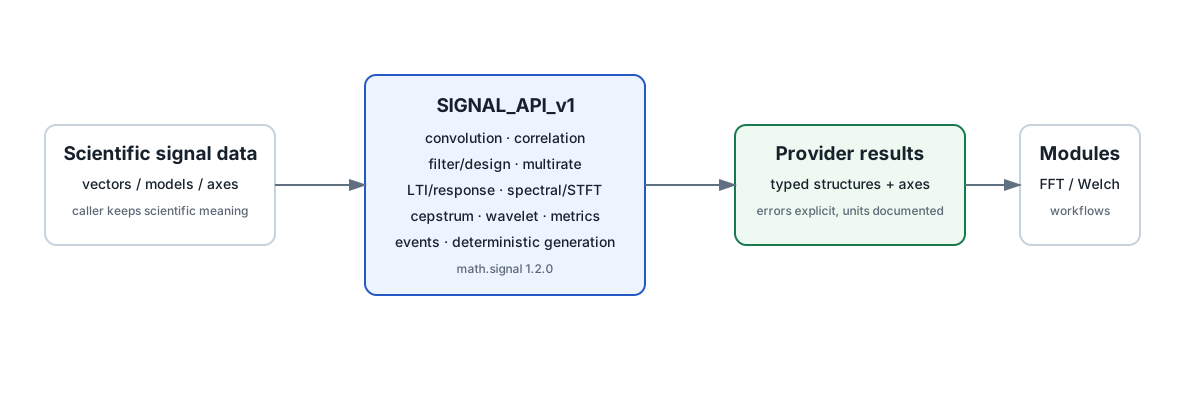
2. Famiglie e operazioni pubbliche
| Family | Operations |
|---|---|
convolution | linear, circular, deconvolve |
correlation | auto, cross, delay |
filter | inspect, causal, zero_phase, sos |
design | butterworth, chebyshev1, chebyshev2, elliptic, bessel, estimate_order, fir_window |
multirate | decimate, interpolate, rational |
lti | inspect, tf, zpk, ss, zoh, tustin, foh, prewarp, matched |
response | evaluate, frequency, impulse, step, input |
spectral | periodogram, welch, cross_psd, coherence, frf_h1, frf_h2, asd, window_metrics |
stft | forward, inverse |
analytic | signal, envelope, phase, instantaneous_frequency |
frequency_metric | gain, group_delay, phase_delay, peak, resonance, bandwidth, q, margins |
time_metric | step, slew, pulse |
quality | basic, snr, harmonics, spectrum |
events | crossings, period, delay |
cepstrum | real, complex, inverse, lifter |
wavelet | dwt, inverse_dwt, cwt, scalogram |
generate | sine, multi_tone, chirp, square, pulse, impulse, white_noise, colored_noise, am, fm |
3. Convolution e correlation
Convolution combina segnale e kernel/sistema; correlation misura similarità a diversi lag. Cross-correlation e delay sono utili per ritardi fra segnali, ma richiedono grid e semantica coerenti.
4. Filter e design
Supporta applicazione causal/zero-phase/SOS e design Butterworth, Chebyshev, elliptic, Bessel e FIR-window. Ordine, cutoff/ripple e band type sono espliciti; richieste non valide falliscono invece di essere silently adjusted.
5. LTI e responses
Transfer function, zero-pole-gain e state-space sono rappresentazioni di sistemi lineari. L'API può ispezionare, discretizzare e calcolare frequency/impulse/step/input responses. Per MIMO e coefficienti complessi alcune conversioni sono deliberatamente limitate.
6. Spectral e STFT
Periodogram/Welch/cross PSD/coherence/FRF e ASD sono primitive; STFT forward/inverse fornisce una rappresentazione tempo-frequenza e ricostruzione overlap-add.
7. Cepstrum e wavelet
Cepstrum evidenzia periodicità nella struttura spettrale. Wavelet permette DWT/CWT/scalogram con scale dichiarate; è un'analisi multi-risoluzione distinta dalla STFT.
8. Metriche
frequency_metric, time_metric e quality producono bandwidth, Q, delay, margins, rise/fall/settling, slew, pulse width, SNR, harmonic quality e spectrum-quality metrics come SINAD/THD+N/SFDR/ENOB quando le condizioni richieste sono rispettate.
9. Generazione deterministica
generate.* produce sine, multi-tone, chirp, square/pulse/impulse, noise seeded, AM e FM. Noise richiede un seed per garantire riproducibilità.
10. Script Bridge
La dev-031 rende script-callable un ampio sottoinsieme delle operations. La reference completa di SIGNAL_API può essere più ricca della coverage corrente del Bridge; verifica sempre gxtxt_api_describe('SIGNAL_API_v1') prima di assumere che una nuova operation sia disponibile allo script.
11. Collegamenti
Riferimento tecnico completo
Questa parte raccoglie integralmente la documentazione tecnica pertinente distribuita con GX-TXT per gli argomenti e i moduli trattati in questa pagina.
SIGNAL_API_v1
SIGNAL_API_v1
Provider: math.signal 1.0.0. API ID/version:
SIGNAL_API_v1/1. This service supplies reusable signal and
LTI mathematics for imported or measured data. It produces values and
diagnostics; Dataset publication belongs to the existing GX-TXT
Publication API. GNU Octave 9.4 and installed signal/control packages
are the current backend. Operations are serial and create no worker
pool.
Public bindings and discovery
- GNU Octave:
gxtxt_signal_v1(family, action, a, b, c, options). - Tcl:
::GX::SignalAPIv1::call family action a b c ?options?after::GX::modulePublicApiActivate math.signal SIGNAL_API_v1. - Registered Octave/Python scripts:
gxtxt_api_require('SIGNAL_API_v1@1:math.signal'), thengxtxt_api_call('SIGNAL_API_v1','family.action',{a,b,c,options})in Octave or a Python list of the same operands. ::GX::SignalAPIv1::apiInfo,listOperations, andoperationMetadata idexpose machine-readable provider identity and the operation catalog. The Script Bridge describes each operation as well.
The Tcl and Script Bridge bindings use typed nodes. An array is
{kind=array, shape=[rows,columns,...], real=[values in column-major order], imaginary=[optional matching values]}.
Other nodes are {kind=empty},
{kind=text,value=...},
{kind=cell,items=[nodes]}, and
{kind=struct,fields={name:node}}. Results use
real/imaginary pairs (value_real,
value_imaginary) and explicit numerical fields. Dimensions
in array nodes are positive; NaN/Inf inputs are rejected. Units are
caller-owned except explicit time,
frequency_hz, and rate fields. The API never guesses
sampling intervals.
Operations
Every row uses the common signature
(family, action, a, b, c, options). Optional operands are
[] in direct Octave or an empty typed node through the
Bridge. Direct Octave accepts ordinary numeric arrays and structs. The
operation IDs are family.action in
api/operations_v1.tsv.
| Family | Actions and operands | Returned fields and assumptions |
|---|---|---|
convolution |
linear, circular, deconvolve;
a=x, b=h |
Linear and circular convolution. Deconvolution uses a frequency-domain regularization parameter and rejects ill-conditioned unregularized kernels. |
correlation |
auto, cross, delay;
a=x, b=y |
Correlation, integer lags, peak delay.
normalization=none|biased|unbiased|coefficient; complex
correlation conjugates the second signal. sample_rate adds
seconds. |
filter |
inspect, causal, zero_phase,
sos; a model struct with numerator/denominator
or SOS, b samples, c initial state |
Causal final state, pole stability and zero-phase output. Zero-phase requires sufficient samples and stable IIR poles. SOS has six coefficients per section and one two-sample state row per section. |
design |
butterworth, chebyshev1,
chebyshev2, elliptic, bessel,
fir_window, estimate_order; order and cutoff
or pass/stop edges |
Numerator/denominator and pole fields; SOS for digital IIR order
above one. band=low|high|bandpass|stop,
domain=discrete|analog. Digital cutoff is normalized to
Nyquist; analog cutoff is in rad/s. FIR windows: Hamming, Hann,
Blackman. Order estimation uses pass/stop ripple specifications. |
multirate |
decimate, interpolate,
rational; samples and integer up/down factors |
Anti-alias filtering uses the installed signal package.
sample_rate or a validated uniform input_time
adds output rate and coordinates; start_time preserves a
declared origin. |
lti |
inspect, tf, zpk,
ss, zoh, foh,
tustin, prewarp, matched;
a model struct |
SISO TF/ZPK/state-space conversions, poles, zeros and stability;
MIMO state-space inspection/discretization. Model
kind=tf|zpk|ss, domain=continuous|discrete,
and explicit sample_period for discrete systems. Conversion
to discrete requires an explicit new sample period; prewarping also
requires prewarp_hz. |
response |
evaluate, frequency, impulse,
step, input; model and evaluation vector |
Complex SISO response, magnitude, unwrapped phase, group delay and
time response; MIMO state-space frequency response returns frequency ×
output × input. Frequency input is Hz; time input is seconds.
input accepts initial state in options. |
spectral |
periodogram, welch, asd,
cross_psd, coherence, frf_h1,
frf_h2, window_metrics; samples, second signal
where needed, sample rate |
PSD/ASD/FRF and frequency axis; window coherent gain, power gain and ENBW. Window, overlap fraction and NFFT are explicit options. Welch/FFT analysis modules remain separate workflows. |
stft |
forward, inverse; samples or full
two-sided STFT, window, hop |
Full complex STFT, sample/frequency bins, optional Hz/seconds axes;
inverse uses overlap-add and reports minimum/maximum overlap weight.
pad=true supports endpoint-zero windows such as Hann; pass
returned pad_left and original_length to
inverse options to trim. Uncovered retained samples fail. |
analytic |
signal, envelope, phase,
instantaneous_frequency; real signal, rate for
frequency |
Hilbert analytic signal, amplitude and unwrapped phase. Instantaneous frequency is in Hz. |
frequency_metric |
gain, group_delay,
phase_delay, peak, resonance,
bandwidth, q, margins; frequency
and complex response |
Gain and dB/phase, -3 dB crossing bandwidth, Q, loop-response margins. Margins require the caller to declare that the response is a loop transfer; no feedback interpretation is inferred from data alone. |
time_metric |
step, slew, pulse; time and
real signal |
Explicit thresholds for rise/fall time, settling, overshoot/undershoot, slew, pulse width/duty and period jitter. A step’s baseline and final value can be declared. |
quality |
basic, snr, harmonics,
spectrum; signal, optional noise, sample rate |
RMS, peak, crest factor, DC, SNR and coherent-bin harmonic
power/THD. spectrum reports THD+N, SINAD, SFDR, ENOB, noise
power and median noise floor per bin; it rejects a noncoherent
fundamental frequency to avoid mislabeled leakage. |
events |
crossings, period, delay;
time, real signal, optional second signal |
Linearly interpolated threshold crossings and event timing. Crossing direction is explicit. |
Errors use GXTXT:Signal:* identifiers in Octave and
structured GXTXT SCIENTIFIC <identifier> Tcl codes.
Empty, nonfinite, dimensionally inconsistent and invalid policy inputs
fail explicitly. Singular deconvolution and zero-energy normalization
fail unless the caller chooses a valid conditioning policy. Time and
frequency axes must be strictly increasing where used. Complex values
are supported for convolution, correlation, filtering, spectral and LTI
operations; threshold events and step metrics require real values.
FIR window high-pass and band-stop designs require even order; an odd request fails rather than silently increasing the order. Low/high designs require one edge, while band-pass/stop designs require two increasing edges.
Complex TF/ZPK and state-space inspection, frequency evaluation,
impulse/step/input response and ZOH/bilinear conversion use explicit
polynomial, matrix-exponential or ODE operations because the installed
control package discards imaginary coefficients in several paths.
Complex FOH and matched-pole conversion fail with
GXTXT:Signal:UnsupportedComplexTime; these are later-scope
conversion methods. Real MIMO state-space frequency/time response is
supported; conversion to a scalar TF or ZPK is undefined. For a
continuous impulse with direct feedthrough, the returned sample series
is the regular response and
direct_feedthrough_real/imaginary reports the separate
Dirac coefficient.
Examples
r = gxtxt_signal_v1('convolution','linear',[1;2],[1;1],[],struct());
assert(isequal(r.value_real,[1;3;2]));
from gxtxt import gxtxt_api_require, gxtxt_api_call
gxtxt_api_require('SIGNAL_API_v1@1:math.signal+convolution')
a = {'kind':'array','shape':[2,1],'real':[1,2]}
b = {'kind':'array','shape':[2,1],'real':[1,1]}
r = gxtxt_api_call('SIGNAL_API_v1','convolution.linear',[a,b,{'kind':'empty'}])gxtxt_api_require('SIGNAL_API_v1@1:math.signal+convolution');
a=struct('kind','array','shape',[2 1],'real',[1 2]);
b=struct('kind','array','shape',[2 1],'real',[1 1]);
r=gxtxt_api_call('SIGNAL_API_v1','convolution.linear',{a,b,struct('kind','empty')});