Indice
Versione verificata
| Framework | GX-TXT 0.9.8.10-dev-031 |
|---|---|
| Import generico | acq.audio 1.0.1 |
| Import PCM WAV | acq.wav 1.0.0 |
| Decoder numerico | analysis.audio_decode 2.0.1 |
1. I due percorsi
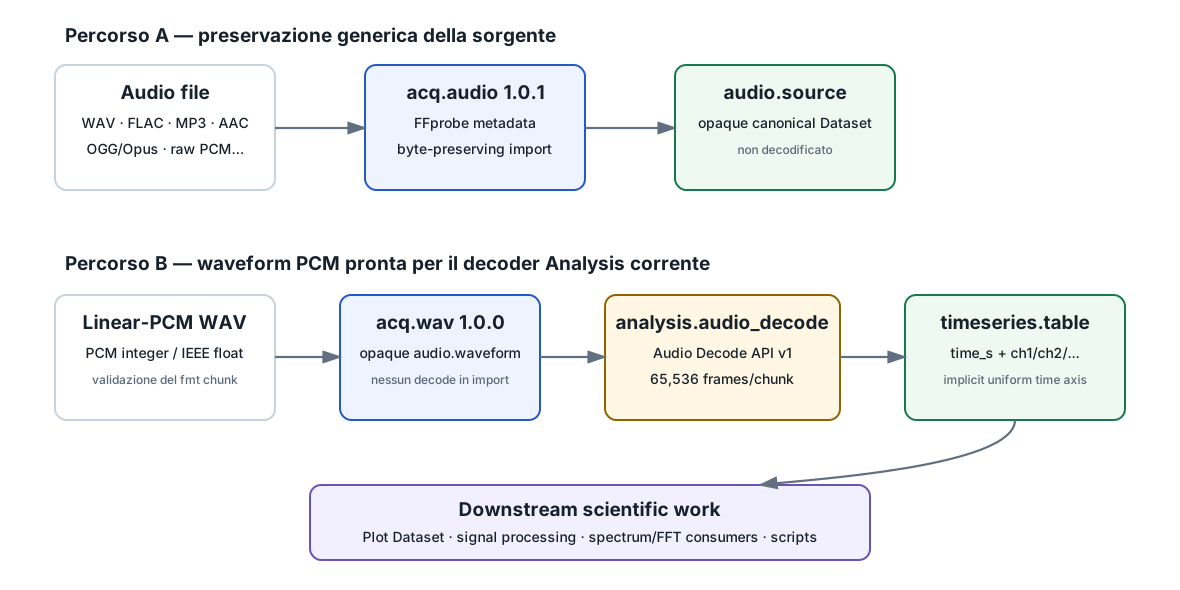
audio.source conserva una sorgente audio generica; audio.waveform rappresenta una sorgente PCM neutra adatta al decoder Analysis attuale.2. acq.audio: sorgenti audio generiche
acq.audio importa sorgenti self-describing supportate da Audio Decode API / FFmpeg+FFprobe, ad esempio WAV, FLAC, MP3, AAC/M4A, OGG/Vorbis/Opus e altri formati riconosciuti dall'installazione corrente.
Può inoltre importare raw PCM headerless .pcm/.raw, ma soltanto se specifichi esplicitamente:
- sample format (
u8,s16le,s24le,f32le, ecc.); - sample rate;
- numero di canali.
Non inferisce questi dati dal filename o dalla dimensione del file.
3. Il contract audio.source
L'output è un Dataset opaco audio.source. I byte originali restano autorevoli e vengono conservati byte-for-byte. L'importatore non:
- decodifica campioni;
- normalizza;
- resampla;
- mixa canali;
- genera colonne tempo/ampiezza.
FFprobe technical metadata e tag vengono invece pubblicati attraverso Dataset Metadata API.
4. Metadata audio
Fra i campi possibili:
audio.container
audio.codec
audio.sample_rate_hz
audio.channels
audio.channel_layout
audio.sample_format
audio.bits_per_sample
audio.title
audio.artist
audio.album
tags.container.*
tags.stream.*
I metadata non cambiano l'identità o i byte della sorgente.
5. Raw PCM
I tre parametri raw PCM sono configuration fields del modulo e quindi valgono per l'intero batch corrente. Se file raw diversi hanno sample format, rate o channel count differenti, importali in passaggi incrementali separati.
6. acq.wav: WAV linear-PCM neutro
acq.wav ha un obiettivo più stretto: accetta soltanto WAV con linear PCM integer o IEEE float, verificando il contenuto del fmt chunk e non la sola estensione.
Un WAV contenente ADPCM, mu-law o MP3 viene rifiutato anche se termina in .wav.
L'output è un Dataset binario opaco audio.waveform. Anche qui l'import non effettua decoding.
7. Quale importatore scegliere?
| Scopo | Scelta |
|---|---|
| Archiviare/preservare MP3, FLAC, AAC, OGG o audio generico | acq.audio → audio.source |
| Archiviare raw PCM headerless con parametri espliciti | acq.audio → audio.source |
| Importare WAV linear-PCM e poi usare il decoder Analysis corrente | acq.wav → audio.waveform |
analysis.audio_decode dichiara come input audio.waveform. Non assumere che un generico audio.source venga accettato automaticamente dal modulo solo perché CORE Audio Decode API può riconoscere più codec.
8. analysis.audio_decode
Il decoder Analysis usa CORE Audio Decode API v1 e Dataset Publication API v2. I campioni vengono elaborati a blocchi di 65.536 frames e pubblicati senza creare un PCM intermedio completo né un grande CSV decimale.
Storage Auto sceglie un provider con capability append/typed numeric/implicit axis appropriate.
9. Dataset numerico risultante
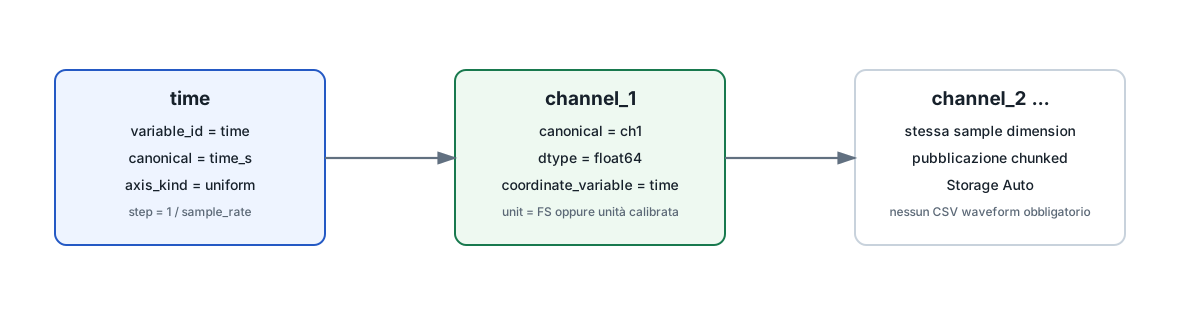
Identità logiche:
dimension_id = sample
coordinate variable_id = time
channel variable_ids = channel_1, channel_2, ...
Nomi canonici compatibili:
time_s
ch1
ch2
...
10. Tempo implicito
La coordinata tempo non deve essere materializzata una volta per campione:
origin = 0
step   = 1 / sample_rate
count  = decoded frame count
Canonical Dataset API e Table Stream ricostruiscono soltanto l'intervallo richiesto.
11. Ampiezza
La convenzione scientifica del decoder conserva normalized full-scale:
- PCM integer normalizzato a FS;
- floating PCM non clippato artificialmente a ±1;
amplitude_scaleapplica un moltiplicatore lineare;amplitude_unitpuò restareFSoppure rappresentare una unità calibrata, per esempio V.
12. Multi-channel
L'importatore audio generico conserva il numero/layout canali come metadata. Il decoder crea invece variabili numeriche separate per i canali decodificati, tutte riferite alla stessa coordinata temporale.
13. Downstream
Un timeseries.table audio decodificato può essere letto da Canonical Dataset API, Table Stream e Plot Dataset e costituisce la base per analisi di segnale/spettro compatibili.
14. Guide collegate
- Dataset e Variable ID.
- Scientific Dataset Plot.
- Guida alle API reference utilizzabili con Script Bridge.
Riferimento tecnico completo
Questa parte raccoglie integralmente la documentazione tecnica pertinente distribuita con GX-TXT per gli argomenti e i moduli trattati in questa pagina.
`acq.audio` 1.0.1
acq.audio 1.0.1
Generic audio-file acquisition module integrated as a protected GX-TXT CORE module in GX-TXT 0.9.7.63.
It imports self-describing formats supported by the public GX-TXT
Audio Decode API and explicitly described headerless raw PCM as
byte-preserving audio.source datasets. It supports
framework-owned multi-source batch import and publishes FFprobe
technical/tag metadata through Dataset Metadata API v1. RAW
interpretation fields therefore travel through the normal Dataset
Metadata runtime bridge rather than a private importer sidecar.
The module does not decode, resample, normalize or edit audio. Numeric sample decoding remains a separate downstream analysis responsibility.
See AUDIO_IMPORTER_GUIDE.md
for the complete user and architecture guide.
WAV / PCM raw audio import (`acq.wav`)
WAV / PCM raw audio import
(acq.wav)
Framework >= 0.9.6.
Imports raw (neutral) audio only. Compressed/lossy sources (MP3, AAC, OGG, ADPCM, A-law/mu-law, MP3-in-WAV…) are refused by design: they are not neutral raw sources — their bytes are a codec’s reconstruction recipe, not the measurement. A raw PCM file’s bytes are the measurement, so its RAW snapshot and SHA-256 mean something; a compressed file’s would not.
This importer registers a WAV as a first-class
binary canonical dataset (audio.waveform,
storage_kind=binary, media_type=audio/wav)
using the Binary Dataset Foundation. The bytes are kept
opaque and provenance-anchored. It does
not decode: turning the audio into a time-series is a
separate, downstream step — see analysis.audio_decode,
which produces a timeseries.table the FFT (and any analysis
module) can consume.
Neutrality is checked by content, not by name
WAV is a container: a .wav file may hold compressed
audio (ADPCM, mu-law, even MP3-in-WAV). acq.wav parses the
fmt chunk and accepts only linear PCM —
integer (format 1) or IEEE float (format 3), including
WAVE_FORMAT_EXTENSIBLE. A non-PCM payload is rejected with
an explanation, even if it is named .wav. Refusing by
content, not extension, is what makes the neutrality guarantee real.
Output
One binary audio.waveform dataset per file. Preview
shows codec, sample rate, channels, bit depth and duration (Preview
Descriptor API metadata branch); the payload itself stays opaque.
Dependencies
None. Pure Tcl header inspection; no sample decoding here. (The
downstream analysis.audio_decode step requires
ffmpeg/ffprobe.)
Scope
WAV/PCM raw audio. RF64 / Wave64 (>4 GB) and exotic container
extensions are out of scope and rejected cleanly rather than guessed.
See TODO.md.
Installation
Install the ZIP from the Modules tab (Plugin Install API v1). No core edits.
Audio decode (`analysis.audio_decode`)
Audio decode
(analysis.audio_decode)
Version 2.0.1 safely recalculates its stable decoded Dataset ID through Dataset Publication API v2 same-owner replacement. CORE refuses cross-owner replacement and restores the prior artifact and registry entry if publication does not commit.
Version 2.0.0 modernized the existing GX-TXT audio waveform decoder for the Large Dataset architecture introduced by GX-TXT 0.9.7.28.
The module remains a standard_octave analysis module. It
no longer owns an audio parser, an FFmpeg wrapper, a decoded-file cache,
or a CSV materialization path. Audio decoding is delegated to
CORE Audio Decode API v1 and canonical waveform
publication uses Dataset Publication API v2 with
Storage Auto.
Data flow
audio.waveform source
    -> CORE Audio Decode API v1
    -> bounded decoded chunks
    -> normalized scientific samples
    -> Dataset Publication API v2
    -> Storage Auto
    -> canonical timeseries.table
No complete decoded PCM file and no decimal waveform CSV are created by the normal v2 path.
Scientific representation
The output dataset uses stable logical identities:
dimension_id: sample
coordinate variable_id: time
channel variable_ids: channel_1, channel_2, ...
Display/canonical names remain compatible with the previous module:
time_s
ch1
ch2
...
The time coordinate is an implicit uniform Variable Schema v3 coordinate:
origin = 0
step   = 1 / sample_rate
count  = decoded frame count
The time payload is therefore not stored once per sample. Canonical Dataset API v2 and Table Stream API v3 reconstruct only the requested range.
Channel variables are published as float64, preserving
the scientific output representation of the 1.x module after its decimal
CSV was read back.
Amplitude semantics
The 1.x scientific convention is retained:
- integer PCM is normalized to full scale using the signed PCM denominator;
- floating PCM remains floating full-scale data and is not clipped to +/-1;
amplitude_scaleapplies one linear multiplier after decoding;amplitude_unitlabels the resulting channel variables.
For integer-like sources the module requests int32 from
Audio Decode API v1 and converts with:
sample_FS = int32_sample / 2^31This is exactly equivalent to the 1.0.4 result for the tested PCM16,
PCM24 and PCM32 fixtures. Floating sources request float32
and are converted to the module’s float64 output without
clipping. The deterministic float32 fixture is also exactly equivalent
to 1.0.4.
Audio Decode API v1 intentionally exposes only float32,
int16 and int32 transport formats.
Consequently a source whose original scientific precision exceeds those
transports (for example PCM float64 or integer PCM wider than 32 bits)
cannot retain every precision bit of the old private parser. The module
does not add a private fallback; this limitation is explicit rather than
silently reintroducing module-owned decoding.
Storage
The module requests:
storage = auto
required:  append_write, typed_numeric, implicit_axis
preferred: range_write, sequential_chunks
It does not select HDF5 directly. Under GX-TXT 0.9.7.28 the current Storage Auto policy selects a provider satisfying those capabilities; for the tested waveform path this is HDF5. Downstream consumers use Dataset IDs and Variable IDs, never the provider path.
Chunking
The decode/publication chunk is 65,536 frames. Working waveform memory is bounded by the channel count and current chunk rather than total duration. Publication v2 receives one bounded append per channel for each decoded chunk.
Input format scope
The module consumes the audio.waveform Analysis Source
contract. The current bundled acq.wav acquisition module
supplies neutral linear-PCM WAV sources and therefore remains the normal
GUI path.
CORE Audio Decode API v1 itself is FFmpeg-based and can decode
additional audio containers/codecs. analysis.audio_decode
does not add a second format filter; if another valid GX-TXT source
workflow provides an audio.waveform resource, the public
CORE decoder determines whether it is decodable. Acquisition ownership
is intentionally not changed by this module migration.
Output and downstream access
The published timeseries.table is immediately usable
through:
- Canonical Dataset API v2;
- Table Stream API v3;
plot.datasetwhen it consumes canonical large datasets;- the planned large-dataset migration of
analysis.fft_spectrum; - future Spectrogram and DSP modules;
dataset.extractthrough canonical dataset access.
FFT consumers can obtain the selected channel, sample dimension,
sample count, uniform dt, numeric dtype and bounded ranges
without module-private metadata.
Provenance and diagnostics
Publication v2 automatically records the module ID, effective storage provider, provider version, selection reason, publication/schema/access API versions and canonical SHA-256 in the Dataset Registry.
decode_info.txt records run-level decoder metadata and
diagnostics, including source container/codec/sample format where
reported by Audio Decode API v1, sample rate, channel count, selected
stream, requested decode format, chunk sizes, FFmpeg/FFprobe versions,
Publication v2 capabilities and effective provider. It is a diagnostic
artifact, not scientific identity and not a user note.
The GX-TXT 0.9.7.28 Octave Publication v2 binding does not expose the
optional Tcl publication-definition fields
source_dataset_ids, source,
producer_version or provenance. The module
therefore does not edit the Dataset Registry privately to add them.
GUI
The existing useful controls are retained:
Full-scale to real-unit scale;Amplitude unit.
No FFmpeg arguments, HDF5 paths, writer controls or chunk-transport controls are exposed to users.
Tests
tests/run_audio_decode_test.sh performs:
- deterministic fixture generation;
- static architecture checks;
- a real CORE large-data chain test:
Audio Decode v1 -> Publication v2 -> Storage Auto -> Canonical v2 -> Table Stream v3; - the full
standard_octavemodule integration test when Octave is available.
The Octave integration covers mono/stereo PCM, PCM24/PCM32 exact full-scale mapping, float32, amplitude scaling, multi-chunk data, direct late-range reads, implicit time, Unicode/spaces paths, optional FLAC decoding, failure cleanup and session relocation/copy.
Deployment
analysis.audio_decode is a bundled GX-TXT
module. This source package is for replacing/updating the
bundled module in the framework source tree; it is not intended to
override an installed bundled module through Plugin Install API v1. The
required framework baseline is GX-TXT 0.9.7.28 or newer
with the same public APIs.